Van finance for mobile tyre fitting, including the fit-out
Most lenders will fund the van and leave you to find the cost of the tyre changer, the balancer, the compressor and the electrics out of your own pocket. On a mobile tyre fitting van that is often a third or more of what you need. We have lenders who will fund the whole thing on one agreement.
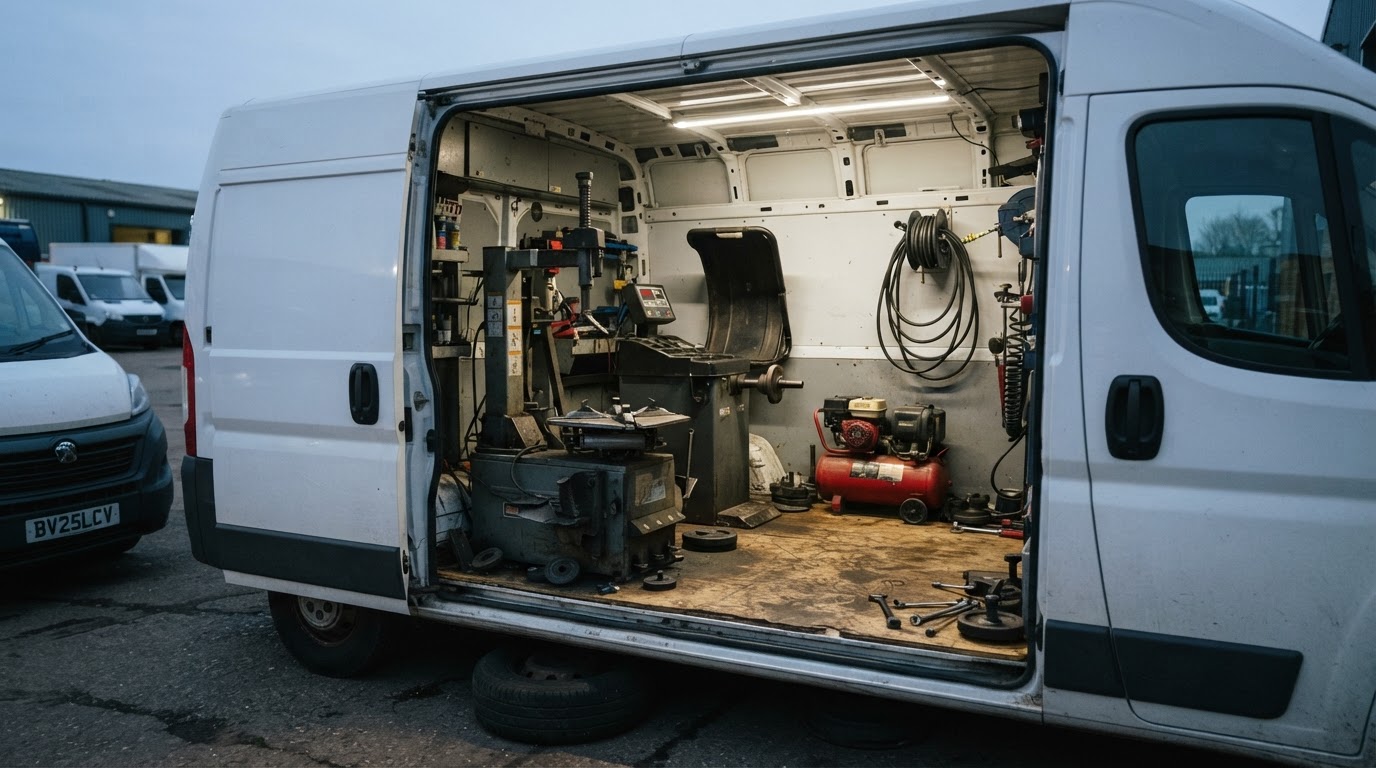
Funding a mobile tyre fitting van including the conversion is possible, but not with most lenders. Most finance companies will fund the vehicle and nothing else, which leaves the business to find the cost of the tyre changer, balancer, compressor, electrics and racking from its own pocket. On a mobile tyre fitting van that equipment is often a third or more of the total. We work with lenders who will fund the van and the fit-out together on a single agreement, and the simplest route is to buy the vehicle ready converted from a specialist so it comes on one invoice.
The problem nobody warns you about
You find the van. You get a quote for the fit-out. You go to a lender.
And the lender funds the van.
Not the tyre changer, not the balancer, not the compressor, not the electrics, not the racking. Just the vehicle. Which leaves you finding the cost of everything that actually makes it a tyre fitting van, in cash, at the exact point in starting a business where you have the least of it.
On the conversions we see, the equipment runs from somewhere around £6,500 plus VAT for a fitted package upwards, and a ready converted used van sits anywhere from about £12,000 to well north of £40,000 depending on the vehicle and the kit. So the bit most lenders will not touch is frequently a third or more of what you need.
We have lenders who will fund the lot on one agreement.
Why most lenders will not do it
Worth understanding, because it tells you what the lender is worried about and therefore what reassures them.
A finance agreement is secured on the asset. If it goes wrong, the lender takes the vehicle back and sells it. That works well on a plain panel van, because a plain panel van has a well understood value and a ready market.
A converted van is a different proposition. If somebody strips the equipment out of the back, a £44,000 asset is suddenly a £25,000 one. The kit is bolted in, it is removable, and it is worth a great deal less second hand than it cost. So a lender funding the conversion is lending against something that can be quietly undone.
That is not an unreasonable worry. It is simply one that some lenders have found a way to price and others have not, and knowing which is which is most of what we do.
A recent one
A brand new business. Not trading yet, no history at all.
The van was £25,995 plus VAT. With the full mobile tyre fitting fit-out in the back, the electrics, the balancing and the tyre changing equipment, the total came to around £44,000 plus VAT.
The customer put in the VAT, and a £1,000 deposit on top of it.
That is a business with no trading history getting a £44,000 asset on the road for a thousand pounds of its own money plus the VAT, which a VAT registered business reclaims on its next return. The lender was flexible because the deal made sense and the case was put to them properly.
We are not promising that every time. We are saying it happened, recently, for somebody who had every reason to assume the answer would be no.
The simplest way to do this
Buy the van ready converted from a specialist.
When the vehicle and the fit-out come from the same supplier on one invoice, the whole thing is one asset, one agreement and one conversation. That is the version lenders are most comfortable with and it is the version we can place most easily.
Plenty of the conversion specialists work this way already. Some buy vans in to your specification and fit them out. Others buy on spec, convert, and sell them ready to go. Either suits.
If you are buying the van and the conversion separately
Be honest with yourself about this one, because it is harder.
Buying a vehicle from one supplier and a conversion from another is not a straightforward thing to fund as a single asset. What we would usually be looking at is financing the van in the normal way, and then looking at an unsecured facility for the conversion, which we can do if the business is strong enough. That would run over a shorter term and it costs more than secured borrowing does, for the reasons set out above.
It works. It is just the long way round, and if you have a choice, the single invoice route is better for you as well as for us.
How the lender looks at the value
Valuing a converted van is genuinely difficult, which is why these cases turn on the strength of the business more than on the paperwork.
A lender being asked to advance £40,000 against a vehicle that would fetch £15,000 stripped is relying on you, not just on the asset. That is why the application matters and why we spend time on it.
One practical consequence worth knowing. Converters do not generally put an expensive fit-out into a cheap old van, because the kit outlasts the vehicle and nobody wants to move it in three years. If you are specifying a conversion, a newer vehicle underneath it makes the whole thing easier to fund as well as more sensible to own.
Other conversions we fund
The same applies well beyond tyre fitting, and the ready converted market is bigger than most people realise.
We arrange finance covering the vehicle and the fit-out for mobile workshops and fitters' vans, recovery and workshop trucks, plant and digger vans, utility and service vehicles, refrigeration, welfare vans and mobile valeting. Mobile workshops in particular cover a lot of ground, from vehicle repair to engineers servicing plant and construction equipment out on site.
Catering conversions too, which have a page of their own.
If your trade involves a van with something substantial built into the back of it, the question is worth asking.
Are you a converter or a dealer?
If you build these vans or sell them, you will know the conversation. A customer who wants the van, wants the fit-out, and can fund one but not the other.
That is a sale you are currently at risk of losing, and it is a problem we can take off you. We work with dealers and converters whose customers need funding for the whole package rather than just the vehicle, and there is more on how we work with introducers if you want the detail.
What we need and how long it takes
A few months of business bank statements and the invoice or quotation covering the vehicle and the conversion.
It can move quickly, often within a couple of days, and what sets the pace is almost always how fast the paperwork arrives rather than anything at our end. If the conversion is being specified rather than bought off the shelf, the earlier we see the quotation the better.
Which van suits a mobile tyre fitting business?
Mobile tyre fitting needs standing height inside and room for the changer, balancer and compressor, which points at a long wheelbase high roof panel van. The common base vehicles are a Ford Transit or a Mercedes Sprinter, both of which converters build on regularly. A Ford Transit Custom or a Renault Trafic will take a smaller fit-out if the work is mainly cars and the kit is compact, but the standing height is the thing to check before you commit.
Speak to a specialist
Tell us the van you are looking at and whether the fit-out is included, and we will tell you honestly what is realistic on one agreement and what is not.
Popular van makes we finance


We arrange finance for all major van makes and models. Don't see yours? Call us on 01730 777 736.
Apply for van finance
Send us what you are looking at, the vehicle and the conversion, and we will tell you honestly what is realistic. Limited company finance from £10,000. No obligation and no upfront fees.
If you'd prefer to call: 01730 777 736
Frequently asked questions
Tell us about the van and the fit-out
Send us what you are looking at, the vehicle and the conversion, and we will tell you honestly what is realistic. If you have a quotation from a converter, that is the quickest place to start. No obligation and no upfront fees.